
The protracted confrontation between Washington and Tehran has reached a critical juncture. Following a high-stakes series of diplomatic exchanges and military maneuvers across West Asia, U.S. President Donald Trump has issued an explicit ultimatum to the international community. In a sweeping statement, the administration declared an “Economic D-Day,” warning that any nation, corporation, or financial entity providing a lifeline to Iran will face severe economic isolation from the United States.
This dramatic shift follows the expiration of a 60-day memorandum of understanding that had temporarily paused direct hostilites. With diplomatic channels stalled and the crucial maritime passages of the Gulf remaining tightly monitored, Washington is pivoting entirely to a strategy of total economic blockade. The objective is clear: enforce maximum pressure to bring Tehran back to the negotiating table or permanently sever its ability to fund its regional footprint.
The “Economic D-Day” Ultimatum
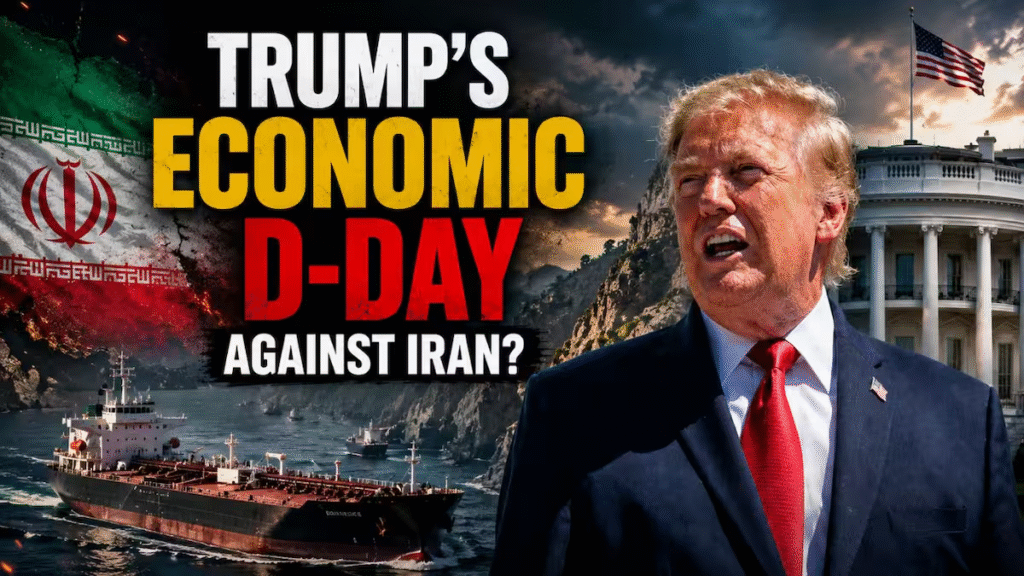
President Trump outlined the scope of the campaign on Truth Social, describing it as “the most crushing economic operation ever taken against any country.” The declaration signals a move beyond traditional bilateral sanctions, expanding the framework to encompass strict secondary enforcement against third-party nations.
THE “ECONOMIC D-DAY” ULTMATUM
- Target Entities : Global banks, shipping lines, airports, front companies, and exchange houses
- Primary Geographic Focus : Eastern Asia (teapot refineries), Gulf trade hubs, transit corridors
- Targeted Practices : Oil smuggling, swap lines, cash transfers ship re-flagging, shadow banking
- Core Strategic Goal : Complete economic isolation of Iran; enforcement of Hormuz security
The warning targets the complex financial and logistical networks that keep Iranian commerce moving. In particular, the U.S. executive branch emphasized that financial institutions, commercial airports, maritime vessel registries, and sovereign entities facilitating trade with Tehran will face immediate exclusion from the U.S. financial system.
“ANY country that allows its financial institutions, businesses, airports, or government entities to provide any type of lifeline to Iran will itself face TREMENDOUS Economic Consequences,” Trump wrote. “Oil smuggling, swap lines, cash transfers, exchange houses, ship registries, front companies—It all needs to stop NOW. You know who you are.”
While explicit technical directives remain to be formalized by the U.S. Department of the Treasury, the broad wording serves as a preventative measure aimed at discouraging global banks and energy traders from handling Iranian transactions.
Regional Fallout: The UAE Severance and Persian Gulf Tension
The impact of the announcement was immediately felt across the trade networks of the Persian Gulf. The United Arab Emirates—historically a primary transit hub for regional trade and home to a significant U.S. military presence—announced a total suspension of all commercial, financial, and trade operations with Iran.
- Immediate Cease on Operations: The Emirati Ministry of Economy and financial regulators instructed domestic exchange houses, shipping firms, and banking institutions to cease processing payments or trade clearances linked to Iranian entities.
- Maritime Incidents: The decision coincided with statements from the UAE Defence Ministry reporting the detection of ballistic missile activity over the sea, an allegation Iranian state media dismissed as unfounded.
- Tehran’s Counter-Warning: Iranian military leaders warned neighboring states across the Gulf against supporting foreign military operations, cautioning that facilitating naval blockades or airspace access would be viewed as hostile collusion.
For decades, Iranian businesses relied on Dubai’s diverse financial network and trading houses to conduct cross-border swap lines and currency exchanges. The UAE’s formal decoupling severely restricts Tehran’s immediate access to hard currency, further tightening liquidity inside the country.
The Geopolitical Crossroads: Friction with China and Eastern Buyers
The ultimate efficacy of Washington’s secondary sanction drive depends heavily on how major energy importers, particularly China, choose to respond.
UNITED STATES SANCTION PRESSURE
CHINA & EAST ASIA
• Buys >80% of Iranian crude
• “Teapot” refineries target
• Risk of major trade friction
GULF NEIGHBORS & ALLIES
• UAE severs all trade ties
• Oman mediates Hormuz talks
• High exposure to strikes
China remains the single largest buyer of Iranian crude, accounting for over 80% of total Iranian maritime exports according to energy tracking data. The bulk of these shipments flow to independent, privately owned processing plants—commonly referred to as “teapot” refineries—primarily concentrated in Shandong province.
Operation Economic Fury and Secondary Targets
Under the ongoing joint Treasury and Pentagon initiative known as Operation Economic Fury, the United States has gradually expanded sanctions to cover non-state processors, shadow-fleet tankers, and regional ship-to-ship transfer operators.
However, Beijing’s Ministry of Commerce has repeatedly rejected unilateral secondary sanctions, stating that such measures violate international trade norms. China has instructed domestic entities to ignore foreign extraterritorial restrictions, setting up a potential economic conflict if Washington moves to penalize major state-owned Chinese banks or ports that handle energy imports.
Energy Markets and the Strait of Hormuz Bottleneck
The ongoing standoff has kept global energy markets on edge. The Strait of Hormuz—a narrow choke point bounded by northern Iran and the Arabian Peninsula—handles approximately 20% of the world’s daily petroleum supply and a significant portion of liquefied natural gas (LNG).
GLOBAL OIL FLOW THROUGH HORMUZ (Pre-War vs. Active Conflict)
Pre-War Normal: 100% (~20% Global)
Active Conflict: 15-20% (Restricted Transit)
- Benchmark Crude Fluctuations: Benchmark Brent crude has hovered near elevated levels above $90 per barrel as market participants factor in transit risk insurance premiums and potential supply disruptions.
- Mediation Efforts in Muscat: Oman continues to host discrete diplomatic exchanges aimed at establishing safe transit corridors through the Strait, though a permanent maritime security agreement remains unratified.
- Fiscal and Domestic Considerations: The disruption to energy supply chains arrives alongside broader global economic headwinds, including rising U.S. public debt levels that recently surpassed $40 trillion, driven in part by higher defense costs and interest rates.
Iran’s Internal Position and the Strategic Standoff
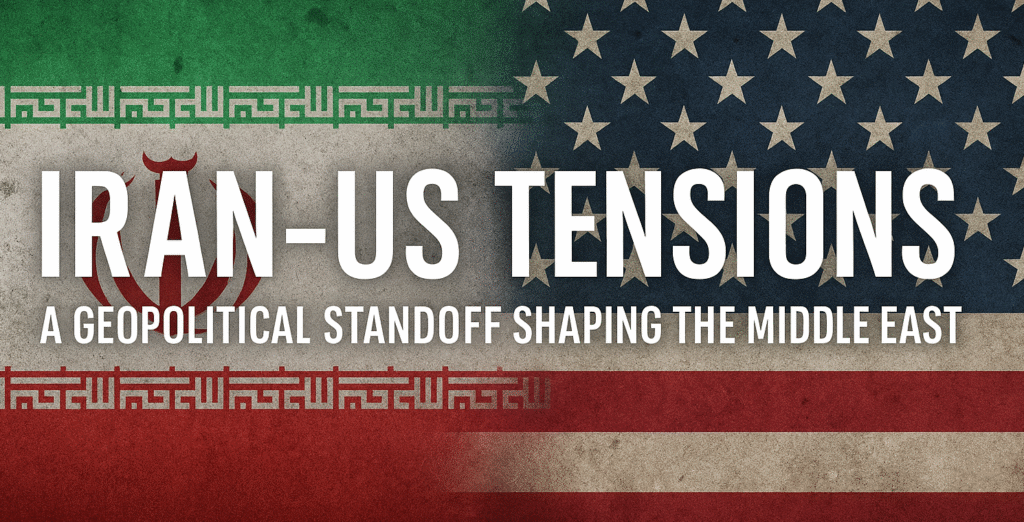
Inside Iran, state officials and media outlets have pushed back forcefully against the White House’s economic campaign. Government representatives in Tehran have characterized the measures as a continuation of previous failed “maximum pressure” policies, maintaining that the state’s internal financial systems and defensive capabilities remain sound.
- Domestic Mobilization: Iranian analysts argue that external economic threats often lead to internal consolidation, uniting political factions around state sovereignty rather than fracturing domestic stability.
- Diplomatic Stance: Advisers to the leadership have indicated that while Iran remains open to structured dialogue, it will not negotiate under conditions of economic coercion or surrender its nuclear energy infrastructure.
- Broader Regional Impacts: The conflict’s secondary effects continue to reverberate through neighboring territories, impacting trade infrastructure in Iraq, security dynamics across the Levant, and international shipping lanes through the Red Sea.
As Washington ramps up secondary sanction enforcement under its “Economic D-Day” framework, the international community faces a complex matrix of geopolitical trade decisions. The coming months will test whether global financial institutions choose to fully sever ties with Iranian networks or if alternative trade mechanisms will emerge to sustain commercial flows amid ongoing uncertainty.